Anima LoRA Training · LoRA Training
Train a custom LoRA on the Anima image model using your own images and captions. Upload a dataset, configure training, and download a .safetensors file ready for any Anima workflow.
anima
fine-tuning
image generation
lora training
736



ABOUT THE WORKFLOW
Train a LoRA
Upload a set of images with matching text captions, set your training parameters, and get a LoRA file back. The LoRA works with any Anima generation workflow. Checkpoints save during training so you can compare early and late results.
Model
Anima v1.0 by CircleStone Labs and Comfy Org. A 2-billion-parameter image model fine-tuned from NVIDIA Cosmos-Predict2-2B, strong at anime, illustration, and non-photorealistic art.
HOW IT WORKS
Step 1. Prepare your training images
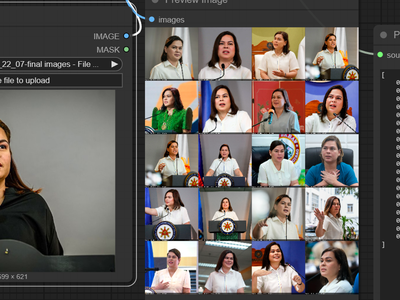
Put your images and their caption files together in one folder. Every image needs a .txt caption file with exactly the same name, in the same folder. For example, 001.png needs 001.txt next to it. If an image has no caption file, training won't work correctly.
No captions yet? Run your images through Detailed Auto Caption first. It writes a .txt file for every image and resizes the images for training.
Works great with: character sheets · style references · illustration sets
Step 2. Point the workflow at your dataset folder
Open the File Browser (the folder icon on the left side of the canvas).
Upload your dataset folder into #inputs.
Open the three-dot menu on the folder and choose Copy Path.
Paste it into the [dataset path field name] on the training node. It should look like this:
#inputs/my_datasetIs your dataset in #outputs or #models? (For example, a folder Detailed Auto Caption just created.) Choose Copy path as input instead. It adds the (as-input) prefix automatically:
(as-input)#outputs/my_dataset_captionedFolders inside #inputs don't need the prefix.
Step 3. Set a class token (optional)
A trigger word that gets added to every caption automatically. Useful when training a specific character or concept.
Step 4. Name your output (optional)
Choose a filename for the finished LoRA. The default is “anima_lora.”
Step 5. Hit run and wait
Training runs for your chosen number of steps, saving a checkpoint every 250 steps. The finished .safetensors LoRA file lands in your outputs folder.
Ready for: any Anima text-to-image workflow · ComfyUI
First time? Leave every setting as-is. The defaults (1024px, 1500 steps, learning rate 0.0001) are the right starting point for almost everyone.
RECOMMENDED SETTINGS
Quick-start guide. Find the goal that matches yours and copy the settings.
Standard training (most people) — 1024px · 1500 steps · learning rate 0.0001 · rank 16 · save every 250 steps. The right starting point for almost everyone.
Quick test run — Drop max steps to 500. See if the dataset and captions are working before committing to a full training run.
More detail in the LoRA — Raise network dim (rank) above 16. Higher values capture finer detail but produce a larger file and increase overfitting risk.
Training is overfitting — Lower the learning rate below 0.0001, or reduce max steps. Compare checkpoints saved at different step counts to find the sweet spot.
Reproduce an earlier training run — Keep the seed at 42 (or whatever you used). Same seed, same dataset, same settings gives the same result.
Images are different sizes — Match the resolution setting to your average image size. The model accepts 512 to 1536 pixels. Best results at 1024.
Prompt (captions): Write one .txt caption per image. Be specific about what is in the image. Danbooru-style tags, natural language, or both work. “1girl, red hair, school uniform, standing, outdoor, cherry blossoms” is better than “anime girl.” Caption quality matters more than image count.
LEARN
📹 Videos
ComfyUI 101 Free Course ft. Sebastian Kamph
Floyo 101 for Team Collaboration
✨ Quick links
USE CASES
🎨 Original Character Training
Train a LoRA on your character sheets to generate consistent characters across poses, outfits, and scenes.
🖌️ Style Transfer
Feed in a set of illustrations in a specific art style and train a LoRA that applies that look to new prompts.
🎮 Game Asset Consistency
Train on existing game art to generate new assets that match the visual identity of a project.
📐 Concept Art Iteration
Lock in a visual direction early, then generate variations that stay on-model without re-prompting every detail.
WHAT WORKS BEST / WHAT TO AVOID
✅ Works great
10 to 50 well-captioned images of a consistent subject
Diverse angles, poses, and lighting across the dataset
Specific, detailed captions per image
Anime, illustration, and stylized art subjects
⚠️ May produce softer results
Fewer than 5 training images
Vague or identical captions across images
Photorealistic subjects (the base model is weaker here)
Mixed subjects in one training set (e.g. two different characters)
FAQ
What is Anima and who made it?
Anima is a 2-billion-parameter image generation model built by CircleStone Labs and Comfy Org. It is fine-tuned from NVIDIA Cosmos-Predict2-2B and uses a Qwen 3 0.6B text encoder. It is designed for anime, illustration, and non-photorealistic art, and its lightweight architecture makes it well suited to LoRA training.
How many images do I need to train an Anima LoRA?
A good starting point is 10 to 30 images. More images with varied poses, lighting, and angles produce better results than many near-identical shots. Each image needs a matching .txt caption file. Focus on caption quality over image quantity.
What caption format does Anima accept?
Anima accepts Danbooru-style tags, natural language descriptions, or a mix of both. Each image needs a .txt file with the same filename, saved in the same folder as the image. For example, "001.png" needs "001.txt" right next to it. If you don't have captions yet, the Detailed Auto Caption workflow can generate them for you.
Can I use the trained LoRA for commercial projects?
No. Anima uses a non-commercial license from CircleStone Labs, plus the NVIDIA Open Model License for the underlying Cosmos-Predict2 weights. LoRAs trained on Anima inherit those license terms. Check both licenses before using outputs in commercial work.
What does network dim (rank) do in LoRA training?
Network dim controls how much detail the LoRA can capture. The default is 16, which works well for most subjects. Higher values (32, 64) capture finer detail but produce larger files and increase the risk of overfitting. Lower values (4, 8) produce smaller, more general LoRAs.
How do I know if my LoRA is overfitting?
Compare checkpoints saved at different step counts. If early checkpoints (500 steps) look good but later ones (1500 steps) start copying your training images too closely or losing flexibility on new prompts, the LoRA is overfitting. Lower the learning rate, reduce max steps, or add more diverse training images.
How to train an Anima LoRA online?
You can train an Anima LoRA online through Floyo. No installation, no setup, no API key to wire up. Open the workflow in your browser, upload your images and captions, and hit run. Free to try.
How do I give the workflow my dataset folder?
Upload the folder to #inputs in the File Browser, then use the three-dot menu and choose "Copy Path." Paste it into the dataset path field, for example #inputs/my_dataset. If the folder is in #outputs or #models, use "Copy path as input" instead, which adds the (as-input) prefix.
WHY FLOYO?
Floyo is the only platform with team collaboration for ComfyUI in the browser. You run workflows with no install. You share run history, assets, and models across your team. You pay only when you generate. Floyo supports open-source and closed-source models.
A designer runs an edit and likes the result. A teammate opens that exact run from shared history and keeps going. No file handoffs. No version confusion.
For studios and enterprise teams, Floyo adds private workspaces, pooled resources, and a team usage dashboard. Other ComfyUI cloud tools run for one person at a time. Floyo runs for the whole team, with transparent per-generation costs.
Ready to try it?
Upload your training images and their caption files to one folder in #inputs, paste the path, and start your first LoRA training run.
Questions? Watch the free course or check the FAQ above.
Read more