Wan 2.1 RecamMaster · V2V Camera Contro
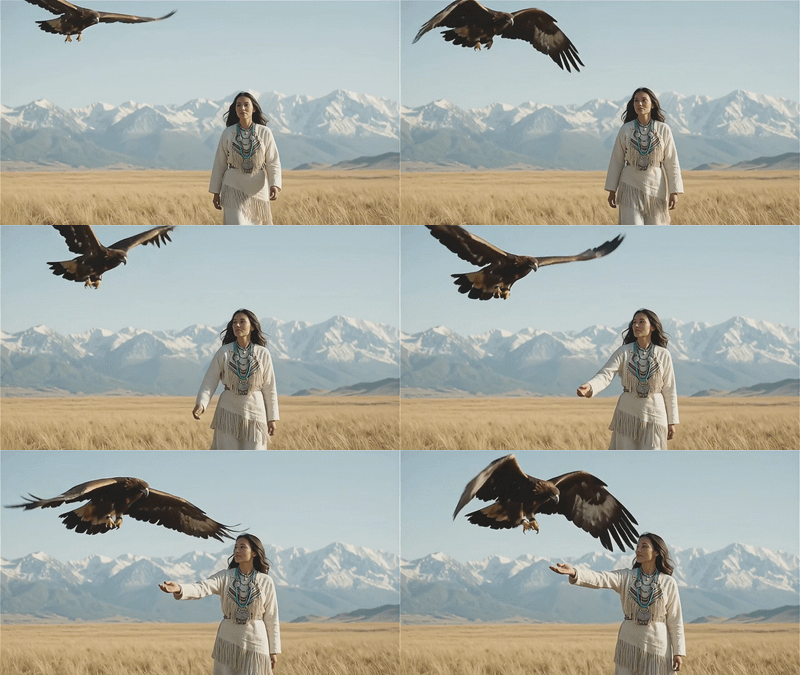
Upload a video and choose a new camera trajectory. RecamMaster on Wan 2.1 regenerates the video with the new camera path while preserving the scene content, motion, and audio.
camera control
LoRAs
pan
recammaster
tilt
Video
video to video
WAN2.1
zoom
288

Nodes & Models
Label (rgthree)
Note
WanVideoEnhanceAVideo
WanVideoLoraSelect
detailz-wan.safetensors
wan2.1-1.3b-control-lora-depth-v0.1_comfy.safetensors
WanVideoTeaCache
INTConstant
WanVideoTorchCompileSettings
WanVideoVAELoader
wan_2.1_vae.safetensors
ImageConcatMulti
LoadWanVideoT5TextEncoder
umt5_xxl_fp16.safetensors
WanVideoExperimentalArgs
ImageResizeKJ
WanVideoDecode
GetImageRangeFromBatch
DownloadAndLoadFlorence2Model
WanVideoReCamMasterCameraEmbed
WanVideoEncode
WanVideoModelLoader
Wan2_1_kwai_recammaster_1_3B_step20000_bf16.safetensors
ReCamMasterPoseVisualizer
WanVideoTextEncode
PreviewImage
Florence2Run
WanVideoSampler
WanVideoReCamMasterDefaultCamera
FloyoStickyNote
ShowText|pysssss
Simple String Combine (WLSH)
VHS_LoadVideo
VHS_VideoCombine
VHS_VideoInfo
ShowText|pysssss
ShowText|pysssss
Simple String Combine (WLSH)
ABOUT THE WORKFLOW
Re-Camera a Video

Upload a video. Choose a camera trajectory such as zoom out, zoom in, pan left, or tilt up. The workflow auto-captions the first frame, encodes the scene, and regenerates the video with the new camera movement applied. The original subject, action, and audio carry over. The output includes the re-camerad video and a side-by-side comparison with the original.
Model
RecamMaster 1.3B by Kuaishou, built on Alibaba's Wan 2.1 architecture. A camera control model that re-renders an existing video along a new camera trajectory while preserving scene content, subject identity, and temporal consistency.
Florence 2 Large FT by Microsoft. Auto-captions the first frame so the text prompt matches the scene without manual writing.
Detailz LoRA (strength 0.8). Enhances fine texture and sharpness in the output.
Wan 2.1 Depth Control LoRA (strength 1.0). Maintains spatial structure from the source video.
HOW IT WORKS
Step 1. Upload your video
The source video you want to re-camera. The workflow loads up to 73 frames and extracts the audio.
Works great with: live-action footage · stock video · AI-generated clips · drone shots
Step 2. Choose the camera trajectory
Select a camera preset: zoom_out, zoom_in, pan_left, pan_right, tilt_up, tilt_down, or other supported paths. The default is zoom_out. The workflow visualizes the camera path before generating.
Step 3. Review the auto-caption
Florence 2 captions the first frame automatically. Edit the prompt if you want to steer the output further, or leave it as-is.
Step 4. Hit run and download
RecamMaster generates the video with the new camera path and returns two MP4s: the output video and a side-by-side comparison with the original. Audio from the source is preserved.
Ready for: Premiere · DaVinci Resolve · After Effects · TikTok · YouTube
First time? Upload a video, leave the camera set to zoom_out, and hit run. The auto-caption and all other settings handle the rest.
RECOMMENDED SETTINGS
Quick-start guide. Find the goal that matches yours and copy the settings.
Standard camera change — Upload your video, pick a camera preset, leave all defaults (25 steps, CFG 6, shift 5, TeaCache on). No other changes needed.
Different camera move — Change the camera preset from zoom_out to zoom_in, pan_left, pan_right, tilt_up, tilt_down, or any other supported trajectory. Each preset defines a full camera path across the clip.
Custom camera path — Use the pose visualizer values (four numeric fields) to define rotation and translation manually. Adjust incrementally and preview the trajectory before generating.
Sharper output — The Detailz LoRA is set to 0.8 by default. Raise it toward 1.0 for stronger texture and edge sharpness. Lower it for a softer, more painterly look.
Faster generation — TeaCache is on by default (threshold 0.1, start step 6). Lower the threshold toward 0.05 for more speed at the cost of some quality. Raise it to disable caching for maximum fidelity.
Scene content drifts or distorts — Edit the auto-generated caption to be more specific about what should stay constant. "A man in a blue jacket walking on a cobblestone street" anchors the scene better than a vague caption.
Prompt: The auto-caption handles most cases. If you edit it, describe what is in the scene, not what the camera should do. Camera movement comes from the trajectory preset, not the text prompt. "A man walking through an autumn forest" is the right kind of prompt. "Zoom out slowly" in the text prompt conflicts with the camera control.
LEARN
📹 Videos
ComfyUI 101 Free Course ft. Sebastian Kamph
Floyo 101 for Team Collaboration
✨ Quick links
USE CASES
🎬 Fix Camera Work in Post
Change a static or poorly framed shot into a smooth zoom, pan, or tilt without reshooting.
🚁 Simulate Drone or Crane Moves
Apply a zoom-out or tilt-up trajectory to ground-level footage to simulate an aerial pull-back or crane reveal.
📱 Repurpose Content with New Framing
Take an existing video and re-camera it for a different platform or aspect ratio by applying a pan or zoom that reframes the subject.
🎮 Camera Exploration for Previsualization
Test multiple camera trajectories on the same source clip to compare how different moves read before committing to a final cut.
WHAT WORKS BEST / WHAT TO AVOID
✅ Works great
Videos with clear subjects and consistent lighting
Moderate motion (walking, gesturing, slow action)
Camera presets that complement the existing scene geometry
Source clips under 73 frames (about 3 seconds at 25fps)
⚠️ May produce softer results
Videos with rapid scene cuts or extreme motion blur
Very dark or low-contrast footage where depth estimation is unreliable
Camera trajectories that conflict with the scene layout (panning left when the scene opens to the right)
Source videos much longer than the frame load cap
FAQ
What is RecamMaster?
RecamMaster is a camera re-rendering model by Kuaishou built on the Wan 2.1 video architecture. It takes an existing video and a camera trajectory definition, then regenerates the video with the new camera path applied. The scene content, subject identity, and temporal motion from the original clip carry over while the camera movement changes.
What camera movements does RecamMaster support?
The workflow includes presets for zoom_in, zoom_out, pan_left, pan_right, tilt_up, and tilt_down. You can also define custom camera paths using the four-value pose visualizer for fine-grained rotation and translation control.
Does RecamMaster preserve the original audio?
Yes. The workflow extracts audio from the source video and embeds it in the re-camerad output. The audio passes through unchanged.
How does the auto-caption work?
Florence 2 Large FT by Microsoft analyzes the first frame of the source video and generates a text description automatically. This caption feeds into the text encoder so the model knows what scene to preserve during re-rendering. You can edit the caption for more control.
What is the difference between RecamMaster and standard video-to-video restyle?
A V2V restyle changes the visual style (colors, textures, art direction) while keeping the camera the same. RecamMaster changes the camera trajectory while keeping the visual content the same. The two techniques solve different problems and can be combined in sequence.
Is RecamMaster licensed for commercial use?
RecamMaster is built on Alibaba's open-source Wan 2.1 model, with weights released by Kuaishou. The Detailz and Depth Control LoRAs have their own license terms. Check each component's license on its model page for commercial use in your specific project.
How to run RecamMaster camera control online?
You can run RecamMaster camera control online through Floyo. No installation, no setup, no local GPU needed. Open the workflow in your browser, upload your video, and hit run. Free to try.
WHY FLOYO?
Floyo is the only platform with team collaboration for ComfyUI in the browser. You run workflows with no install. You share run history, assets, and models across your team. You pay only when you generate. Floyo supports open-source and closed-source models.
A designer runs an edit and likes the result. A teammate opens that exact run from shared history and keeps going. No file handoffs. No version confusion.
For studios and enterprise teams, Floyo adds private workspaces, pooled resources, and a team usage dashboard. Other ComfyUI cloud tools run for one person at a time. Floyo runs for the whole team, with transparent per-generation costs.
Ready to try it?
Upload a video, pick a camera trajectory, and hit run.
Questions? Watch the free course or check the FAQ above.
Read more