FLUX.1 Dev · Text to Image With Image Input
Generate images from text with FLUX.1 Dev, the 12B open-weight model from Black Forest Labs. Enable the image input to edit from a picture. Write a prompt, run.
Flux Dev
Image
image to image
photorealism
text to image
2.4k
_1756358901929.png?width=1400&height=620&quality=80&resize=contain)
_1756358907187.png?width=1400&height=620&quality=80&resize=contain)
_1756358919230.png?width=1400&height=620&quality=80&resize=contain)
_1756358919230.png?width=1400&height=620&quality=80&resize=contain)
_1756358901929.png?width=104&height=104&quality=80&resize=cover)
_1756358907187.png?width=104&height=104&quality=80&resize=cover)
_1756358919230.png?width=104&height=104&quality=80&resize=cover)
_1756358919230.png?width=104&height=104&quality=80&resize=cover)

Nodes & Models
PrimitiveFloat
DualCLIPLoader
clip_l.safetensors
t5xxl_fp8_e4m3fn.safetensors
LoadImage
VAELoader
ae.safetensors
JWImageResizeToClosestSDXLResolution
UNETLoader
FLUX1/flux1-dev-fp8.safetensors
VAEEncode
EmptyLatentImage
CLIPTextEncode
KSampler
SaveImage
VAEDecode
ConditioningZeroOut
FluxGuidance
ABOUT THE WORKFLOW
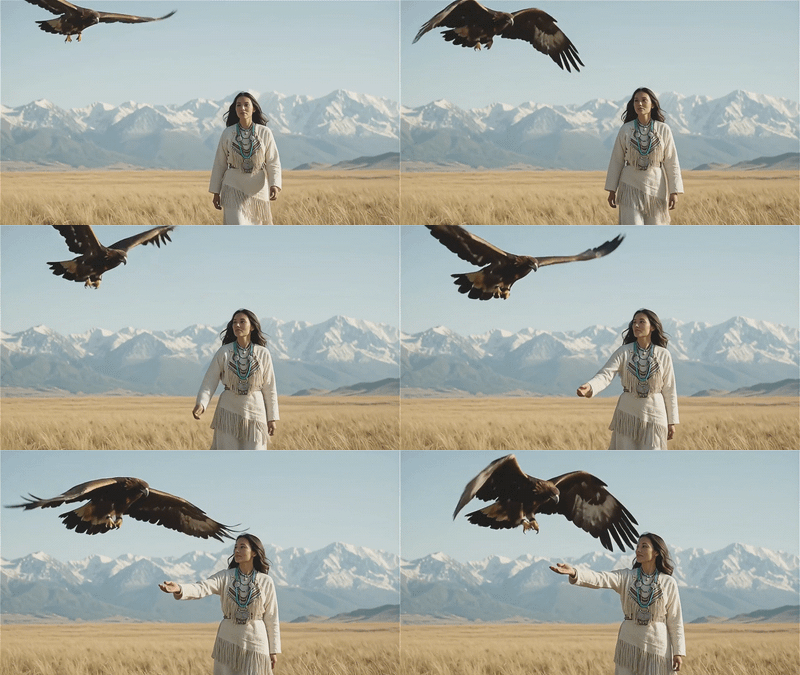
Generate an Image From Text Write a prompt and get a picture. FLUX.1 Dev follows long, detailed prompts closely and produces sharp detail with reliable composition. An optional image input sits inside a muted subgraph. Enable it to start from an existing picture instead of generating from scratch.
Model
FLUX.1 Dev by Black Forest Labs. Released August 2024. A 12 billion parameter rectified flow transformer with T5-XXL and CLIP-L text encoders. Open weights under the FLUX.1 Dev Non-Commercial License. Strong at photorealism, prompt adherence, and text rendering inside images.
HOW IT WORKS
Step 1. Write your prompt Describe the image in natural language. Detailed, multi-sentence prompts produce the strongest results. Works great with: photorealistic stills · portraits · product shots · concept art
Step 2. Enable the image input (optional) The Optional Image subgraph is muted by default. Enable it to upload a picture as the starting point. The denoise slider controls how much the model changes it.
Step 3. Hit run and download The model builds the picture in 20 passes and saves it under ComfyUI. Ready for: Photoshop · Figma · Canva · any editor
First time? Leave every setting as-is. The defaults (1024 x 1024 · 20 steps · guidance 2.5 · random seed) are the right starting point for almost everyone.
RECOMMENDED SETTINGS
Quick-start guide. Find the goal that matches yours and copy the settings.
Standard generation (most people) — 1024 x 1024 · 20 steps · guidance 2.5 · random seed. The right starting point for almost everyone.
Want a different shape — Change width and height in the EmptyLatentImage node. Stay near 1 megapixel total (e.g. 1024 x 768 or 768 x 1344).
The picture drifts from the prompt — Raise guidance above 2.5. Higher values hold the model closer to your words. Too high oversaturates.
Want to edit an existing image — Enable the Optional Image subgraph (right-click, Unmute or Ctrl+M). Upload your picture. Set denoise: 0.7 keeps some of the original, 0.9 changes most of it, 0.3 nudges it.
Want text inside the image — Spell out the exact words in quotes inside the prompt. FLUX.1 Dev renders clean typography at larger sizes.
Faster runs — Lower steps. Quality drops noticeably below 15. For quick tests, 15 steps saves time.
Reproduce a result you liked — Set a fixed seed. The same prompt, size, and seed return the same picture.
Prompt: Write it as a scene description, not keywords. "A photorealistic glass bottle containing a miniature purple galaxy landscape, swirling nebulae and stars visible through transparent glass, ethereal lighting, crystal clear reflections, cinematic composition" gives you more than "galaxy bottle." The T5-XXL encoder parses grammar, so full sentences outperform tag lists.
LEARN
📹 Videos
ComfyUI 101 Free Course ft. Sebastian Kamph
Floyo 101 for Team Collaboration
✨ Quick links
USE CASES
📸 Photorealistic Stills Generate photorealistic images with accurate lighting, materials, and spatial relationships from a text description.
🔤 Typography and Design Render clean, readable text inside images for posters, signs, packaging mockups, and social cards.
🎨 Image Editing With Text Enable the image input, upload a picture, lower the denoise, and describe the change. The model edits while keeping the original structure.
🛍️ Product and Marketing Visuals Create lifestyle shots, hero images, and campaign visuals from a prompt without a photo shoot.
WHAT WORKS BEST / WHAT TO AVOID
✅ Works great
Detailed, multi-sentence prompts that describe the full scene
Photorealistic subjects, materials, and lighting
Clean typography and text rendering
Image editing at denoise 0.5 to 0.8
⚠️ May produce softer results
Short keyword prompts with no scene description
Sizes pushed well past 1 megapixel
Denoise below 0.3 when editing (too little change to register)
Work that needs a permissive open-source licence
FAQ
What is FLUX.1 Dev? FLUX.1 Dev is a 12 billion parameter rectified flow transformer from Black Forest Labs, released August 2024. It uses T5-XXL and CLIP-L text encoders and generates images at up to 1 megapixel. It is one of the most widely adopted open-weight image models for photorealism and prompt adherence.
Can this workflow edit an existing image? Yes. The Optional Image subgraph is muted by default. Enable it to upload a picture as the starting point. The denoise slider controls how much the model changes it: 0.7 keeps the structure and changes the details, 0.3 nudges the image, 0.9 rebuilds most of it.
Is FLUX.1 Dev free for commercial use? No. FLUX.1 Dev is released under the FLUX.1 Dev Non-Commercial License, which permits personal, research, and educational use but not commercial use. A commercial licence from Black Forest Labs is available separately. The FLUX.2 Klein 4B model is available under Apache 2.0 if you need a permissive licence.
How does FLUX.1 Dev compare to FLUX.2 Dev? FLUX.2 Dev, released November 2025, is the successor with a larger architecture (32B vs 12B), a Mistral 3 24B VLM encoder (vs T5-XXL), multi-reference conditioning (up to 10 images), and 4-megapixel output. FLUX.1 Dev is lighter, faster, and has a larger ecosystem of LoRAs and extensions. Pick FLUX.1 Dev for speed and compatibility, FLUX.2 Dev for the latest quality.
What resolution should I use? 1024 x 1024 is the default and the model's sweet spot. Stay near 1 megapixel total. Going past 1.5 megapixels can introduce artifacts or duplicate elements.
Can I add a LoRA? This workflow does not include a LoRA loader. The FLUX.1 Dev Upscale with LoRA workflow in the library includes one. To add a LoRA here, insert a LoRA Loader node between the UNet Loader and the sampler inside the Sampling subgraph.
How to run FLUX.1 Dev online? You can run FLUX.1 Dev online through Floyo. No installation, no setup, no model downloads. Open the workflow in your browser, write a prompt, and hit run. Free to try.
WHY FLOYO?
Floyo is the only platform with team collaboration for ComfyUI in the browser. You run workflows with no install. You share run history, assets, and models across your team. You pay only when you generate. Floyo supports open-source and closed-source models.
A designer runs an edit and likes the result. A teammate opens that exact run from shared history and keeps going. No file handoffs. No version confusion.
For studios and enterprise teams, Floyo adds private workspaces, pooled resources, and a team usage dashboard. Other ComfyUI cloud tools run for one person at a time. Floyo runs for the whole team, with transparent per-generation costs.
Ready to try it? Write a prompt and run it. The picture comes back at 1024 x 1024.
Questions? Watch the free course or check the FAQ above.
Read more