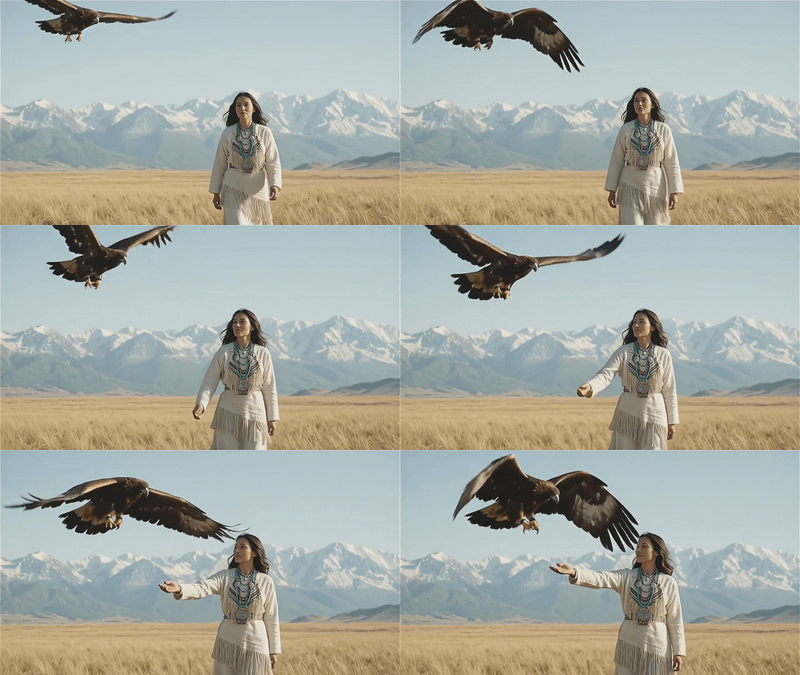
Minimax H3 FLF2V + Orbit LoRA for 360 View
Upload a photo and MiniMax H3 with the Orbit LoRA animates a full 360 camera rotation around it, with synchronized stereo audio, in one pass. Upload, run, download.
360 Orbit LoRA
FLF2V
Image
Minimax H3
Video
20

Nodes & Models
UNETLoader
minimax_h3_fl2va_pruned_int8_convrot.safetensors
CLIPLoader
qwen3vl_32b_minimax_h3_nvfp4_awq.safetensors
VAELoader
minimax_h3_video_vae_fp16.safetensors
minimax_h3_audio_vae_fp32.safetensors
LoadImage
RandomNoise
KSamplerSelect
LoraLoaderModelOnly
minimax_h3_flf2v_lora_v1.safetensors
MiniMaxH3ImageToVideo
MiniMaxH3SigmaShift
BasicScheduler
BasicGuider
SamplerCustomAdvanced
VAEDecode
VAEDecodeAudio
CreateVideo
SaveVideo
ABOUT THE WORKFLOW
Orbit Any Photo in 360
Upload a photo and the camera orbits all the way around the subject in a smooth loop. The same image loads as the first and last frame so the clip wraps back to its own start. A community Orbit LoRA pushes the base model into a full rotation while keeping every object frozen in place. You get a video file with stereo audio.
Model
MiniMax H3 (FL2VA) by MiniMax. A 33B omni-modal video model that generates smooth motion with synchronized stereo audio in one pass. Also known as Hailuo 3.0.
Orbit LoRA by Pablo Dawson. A community LoRA trained on 360 orbit clips that steers the model into a full camera rotation.
HOW IT WORKS
Step 1. Upload your photo
The image you want to orbit around. Use a clear subject with a full visible background so the model has geometry on all sides.
Works great with: products · characters · food · architecture · sculptures
Step 2. Upload the same photo as the last frame
The model sees matching start and end frames, so the video wraps back to its own beginning in a clean loop.
Step 3. Check the prompt
The prompt is pre-filled with orbit instructions that tell the model to freeze everything and move only the camera. Leave it as-is for a standard 360 orbit.
Step 4. Hit run and download
The model generates 73 frames of video with stereo sound in one pass. Preview it in the workflow, then download.
Ready for: social media · product pages · portfolios · presentations
First time? Leave every setting as-is. The defaults (768x768, 73 frames, 28 steps) are the right starting point for almost everyone.
RECOMMENDED SETTINGS
Quick-start guide. Find the goal that matches yours and copy the settings.
Standard 360 orbit (most people) — 768x768, 73 frames, 28 steps, random seed. The right starting point for almost everyone.
Faster preview before committing — Drop steps to 20. The orbit will be rougher but renders faster, so you can test your source image first.
Longer orbit with more detail — Raise the frame count to 90 or 107. Valid counts follow a pattern: 22, 39, 56, 73, 90, 107, 124. Past 90 may fail on consumer GPUs.
Reproduce a result you liked — Lock the seed to the number from your previous run. Same seed plus same image gives the same orbit.
Subject warps or drifts mid-orbit — Try a cleaner source image with a clear subject against a full background before raising steps. The orbit needs visible geometry on all sides.
Want a different camera move — Edit the prompt. Replace the orbit instruction with a different motion description, but keep it specific about what moves and what stays frozen.
Prompt: Pre-filled for a clean 360 orbit. Leave it as-is for standard use. If you need a different camera motion, replace the instruction with a short, specific description of the move. "Slow dolly forward while panning left" works better than "cool camera movement."
LEARN
📹 Videos
ComfyUI 101 Free Course ft. Sebastian Kamph
Floyo 101 for Team Collaboration
✨ Quick links
USE CASES
🛍️ Product Showcases
Upload a product shot and get a 360 orbit video for your store page or social feed. No turntable, no photographer, no 3D scan.
🎨 Portfolio & Character Reveals
Show off a 3D render, figurine, or character design from every angle in a looping clip.
🏠 Architecture & Interior Design
Turn a single photo of a building or room into a rotating view that gives clients a sense of the full space.
📱 Social Media Content
Create eye-catching orbit videos from still photos for Instagram Reels, TikTok, or product teasers.
🎮 Game & VFX Reference
Generate quick 360 turnarounds of props, costumes, or set pieces for pre-production review.
WHAT WORKS BEST / WHAT TO AVOID
✅ Works great
One clear subject against a full visible background
Products, statues, food, characters with distinct edges
Well-lit photos with even exposure
Square or near-square source images
⚠️ May produce softer results
Tight crops with no background visible
Flat or 2D-looking source images (illustrations, logos)
Heavy bokeh or shallow depth of field
Busy scenes with many overlapping subjects
FAQ
What is a 360 orbit video and how is it different from a 360 panorama?
A 360 orbit video moves the camera around a subject while keeping the subject in the center of the frame. The viewer sees the object from every angle, like a turntable. A 360 panorama wraps the entire environment into a sphere that the viewer looks around from inside. This workflow produces the orbit type: one subject, every angle.
What is MiniMax H3 and how does it compare to other AI video models?
MiniMax H3 is a 33B omni-modal video model by MiniMax, also known as Hailuo 3.0. It generates video and stereo audio together in a single pass. For 360 orbits, the combination of first-and-last-frame conditioning and the Orbit LoRA gives it a specific advantage: the model can lock the start and end frames to the same image so the clip loops without a visible seam.
Does MiniMax H3 generate audio with the video?
Yes. MiniMax H3 generates synchronized stereo audio in the same pass as the video frames. The output file includes both picture and sound. For 360 orbits the audio is ambient, since the prompt instructs the model to freeze everything except the camera.
Why do I upload the same image twice as first and last frame?
The model uses the first frame to start the video and the last frame to end it. When both are the same image, the model generates motion that returns to its starting point, creating a clean loop. This is what makes the 360 orbit work as a seamless rotation.
Can I use MiniMax H3 orbit videos for commercial projects?
MiniMax H3 uses open weights under the MiniMax H3 Community License. Commercial use is allowed for organizations with annual revenue under $20 million. Review the full license terms for your situation before using outputs in commercial work.
What frame counts work with MiniMax H3?
Frame counts must follow the formula: frames mod 17 equals 5. Valid counts are 22, 39, 56, 73, 90, 107, and 124. The default is 73 frames, which produces about 3 seconds of video at 24 fps. Counts above 90 may fail on consumer-grade GPUs.
How to run MiniMax H3 360 orbit online?
You can run MiniMax H3 360 orbit online through Floyo. No installation, no setup, no API key to wire up. Open the workflow in your browser, upload your photo, and hit run. Free to try.
WHY FLOYO?
Floyo is the only platform with team collaboration for ComfyUI in the browser. You run workflows with no install. You share run history, assets, and models across your team. You pay only when you generate. Floyo supports open-source and closed-source models.
A designer runs an edit and likes the result. A teammate opens that exact run from shared history and keeps going. No file handoffs. No version confusion.
For studios and enterprise teams, Floyo adds private workspaces, pooled resources, and a team usage dashboard. Other ComfyUI cloud tools run for one person at a time. Floyo runs for the whole team, with transparent per-generation costs.
Ready to try it?
Upload a photo, and the orbit prompt is already set. Hit run.
Questions? Watch the free course or check the FAQ above.
Read more