Detailed Auto Caption
Generate high-quality captions for LoRA training and automatically resize images to SDXL/Flux-compatible resolution.
Captioning
Flux
Image
LoRA
LORA Training
2.7k
Nodes & Models
Florence2ModelLoader
Florence2Run
Florence2ModelLoader
Florence2Run
Text Multiline
LoadImageListFromDir //Inspire
LoadImageListFromDir //Inspire
Florence2Run
easy promptConcat
FL_ImageCaptionSaver
FL_ImageCaptionSaver
Generate highly detailed captions for LoRA training and automatically resize images to SDXL/Flux-compatible resolution.
Key Inputs
Dataset Path: The folder that holds your source images. Upload them into a folder inside #inputs with the File Browser (the folder icon on the left side of the canvas). Then open the three-dot menu on that folder, choose Copy Path, and paste it here. It should look like
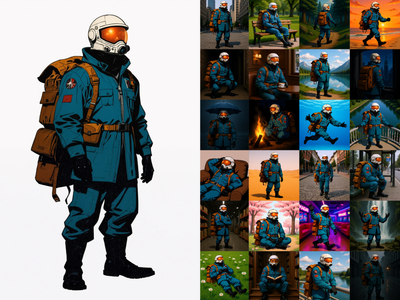
#inputs/my_dataset.Trigger word: A unique word added to the start of every caption, like
ohwx_spaceman. Pick something that isn't a real word so the LoRA learns it as your subject.Output Path: The folder where the resized images and their .txt caption files are saved. Each image gets a caption file with the same name (
image_01.pngandimage_01.txt). It should look like[#outputs/my_dataset_captioned].
Using the results for training
The output folder is ready to use as a dataset for our LoRA trainers. To use it, open the folder's three-dot menu and choose Copy path as input. It's saved outside #inputs, so the path needs the (as-input) prefix, for example (as-input)#outputs/my_dataset_captioned. Paste that into the trainer's dataset path field. Every image needs its matching .txt file, so keep them together in the same folder.
Tips
Use a folder that only has your dataset images in it.
Read through a few captions before you train. Florence-2 is detailed, but it can describe things you don't want the LoRA to learn, like the background or clothing.
Read more