

Platform Comparison
You have a creative challenge. Someone has probably already built an AI workflow that solves it. The harder question is where to run it, and the answer depends on who you are, what you're making, and how much setup you're willing to do. A fair, platform-by-platform look at seven tools that all claim to host AI workflows, with real pros, real cons, and how each one fits.
How the category splits
The "run AI workflows in the cloud" category has quietly split into three kinds of tools. Which kind you pick matters more than the brand name on the box.
Node-canvas creative platforms like Weavy and Flora give you an infinite canvas to design custom pipelines node by node, mixing models from different providers.
ComfyUI cloud hosts like Comfy Cloud, RunningHub, and RunComfy put ComfyUI online so you can skip the local install and the GPU purchase.
GPU infrastructure like Runpod hands you raw compute and expects you to build the rest yourself.
Floyo sits closest to the second group but approaches the problem from a different angle: discovery first, build second, team-first from day one. Here's how each platform shakes out, one by one, with strengths, trade-offs, and where it fits.
Pricing and feature data current as of April 2026.
1. Floyo
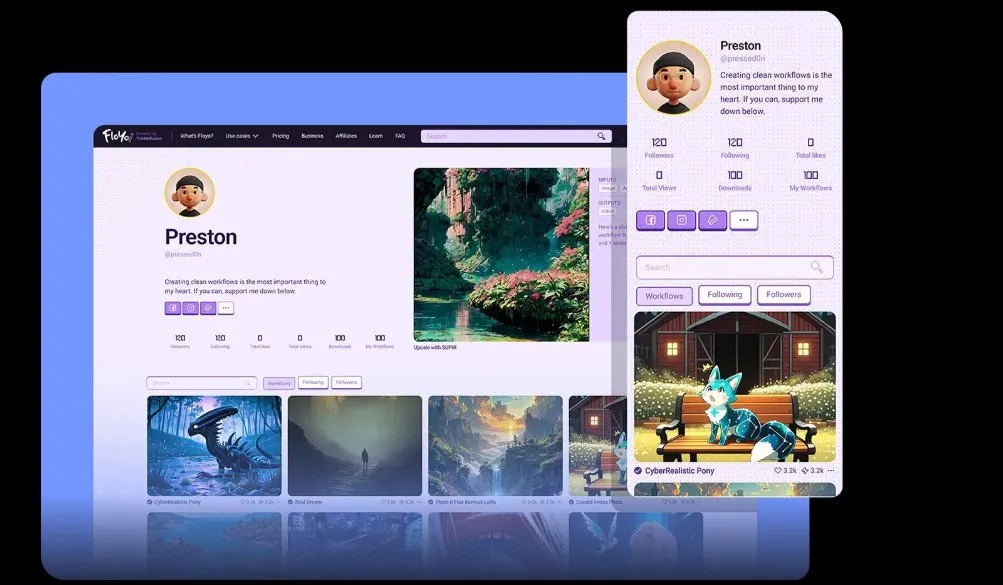
Built by ThinkDiffusion, Floyo is the only ComfyUI cloud platform with real team collaboration: shared run history, shared files and models, workflow pages for organizing pipelines, and a team usage dashboard with pooled billing. The serverless architecture means workflows start instantly, and you only pay when you're actually generating. The full ComfyUI editor is there with 300+ pre-installed custom nodes (new ones added within 48 hours of request), plus in-browser LoRA training on H100 NVL GPUs. Used by Hollywood production teams in private beta for nearly a year before opening to everyone.
- +Floyo API is available: every workflow becomes an endpoint you call from your app, with no Docker, no deploy, and no GPU management
- +Only ComfyUI cloud platform with real team features: shared runs, files, workflow pages, pooled billing
- +Serverless billing means the meter is off while you build, edit, and review. You pay only during generation.
- +H100 NVL GPUs on every plan: 94GB VRAM, 3.9 TB/s memory bandwidth
- +300+ pre-installed custom nodes, with new ones added within 48 hours of request
- +No runtime limit and a 99-item job queue, so you can stack renders and walk away
- −Single GPU tier (H100 NVL), with no cheaper cards for light image-only work
- −Self-service checkpoint uploads not live yet (LoRAs are; checkpoints via support)
- −Community library is smaller than RunningHub's daily-updated ecosystem
- −FloTime plus a separate API Wallet adds more moving parts than a single flat subscription
Every workflow is now an endpoint.
Build it on the canvas. Call it from your app.
Your users never see the workflow. They see your product.
Use any visual workflow you can imagine. You never need another API endpoint to access AI visual asset generation again.
2. Figma Weave (Weavy)
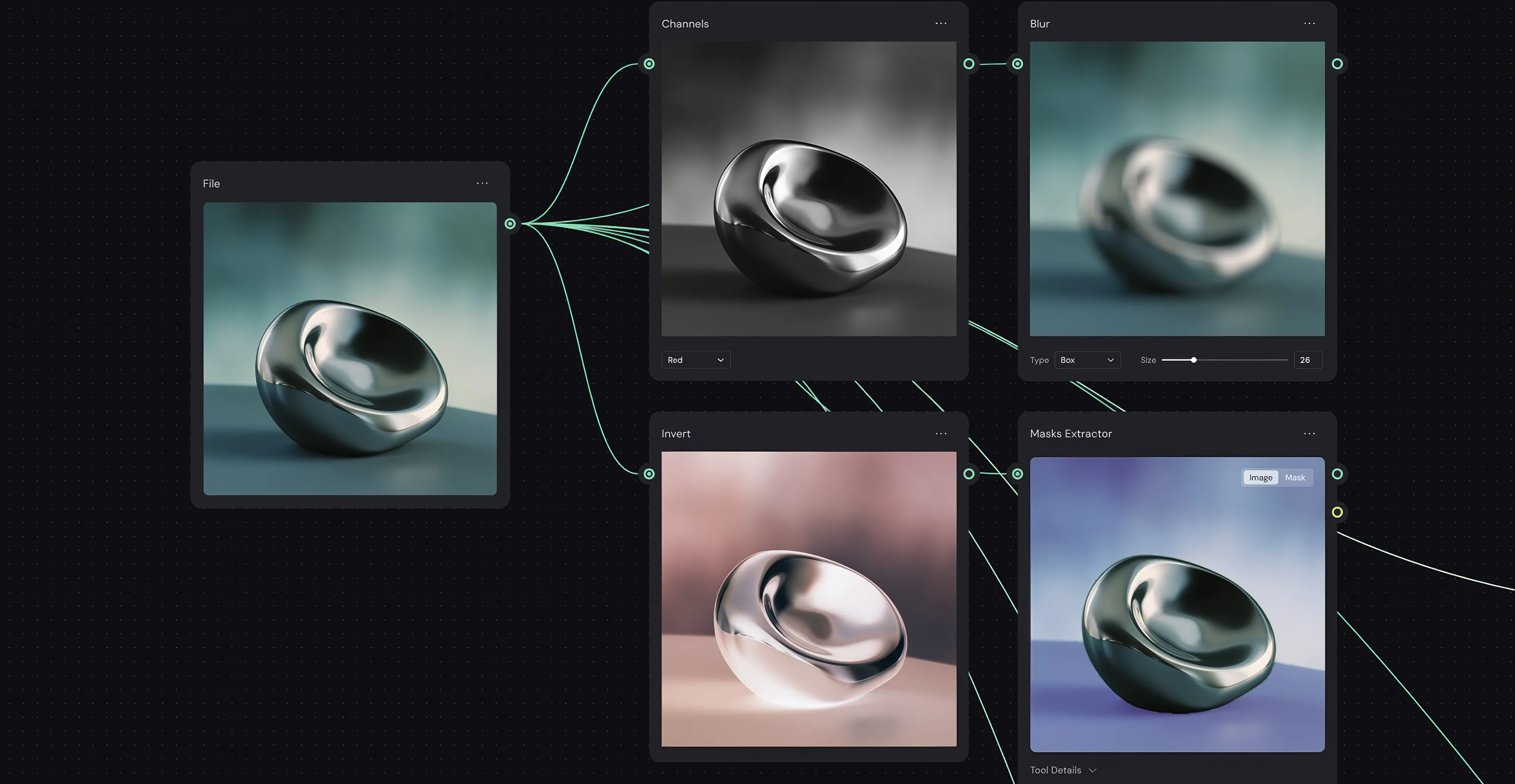
A node-based infinite canvas that pulls together models from Google, OpenAI, Black Forest Labs, Kling, Runway, Luma, Bytedance, and more. Acquired by Figma in late 2025 and rebranded from Weavy, it's built for professional design, cinematography, and VFX teams who want to design reproducible multi-model pipelines from scratch.
- +Widest model roster in one canvas: Google, OpenAI, BFL, Runway, Luma, Kling, and more
- +Reusable node pipelines ideal for team standardization
- +Commercial rights cleared on most models, no training on your data
- +Figma acquisition provides long-term platform stability
- +Team plan with credits management for tracking usage across members
- −Steep learning curve. The canvas paradigm takes real time to master.
- −Figma and Figma Weave still billed as separate products
- −No quick-start prebuilt workflows; build-from-scratch mindset
- −Video model generations burn credits fast at scale
- −Not suited for users who want a one-click run experience
3. Flora (Flora Fauna)
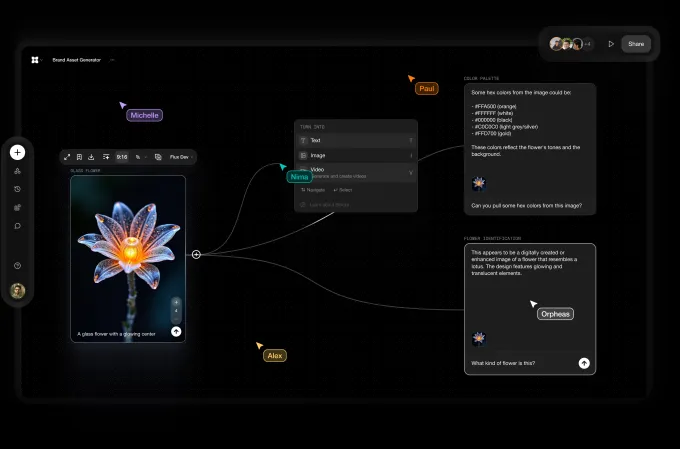
Another infinite-canvas node platform, used by agencies like Pentagram and studios like Lionsgate, with a $42M Series A from Redpoint in January 2026. The standout feature is Style DNA: train a consistent aesthetic once, and apply it across every node. That matters when brand consistency is the whole point and random-looking outputs are a problem.
- +Style DNA system delivers consistent brand aesthetic across generations
- +Proven with pro agencies: Pentagram, Lionsgate, Alibaba, Brex
- +Clean Figma/Miro-style canvas that designers learn quickly
- +Approachable $16/month entry price on annual billing
- +Well-funded ($42M Series A), with strong long-term viability
- −Curated model set (Flux 2, Seedream, Veo) rather than an open buffet
- −No real-time co-editing. Commenting and sharing only.
- −Credit burn on video models is expensive at scale
- −No built-in character consistency. DIY through references and Style DNA.
- −Entry price may be a market-capture rate that rises as usage scales
4. Comfy Cloud
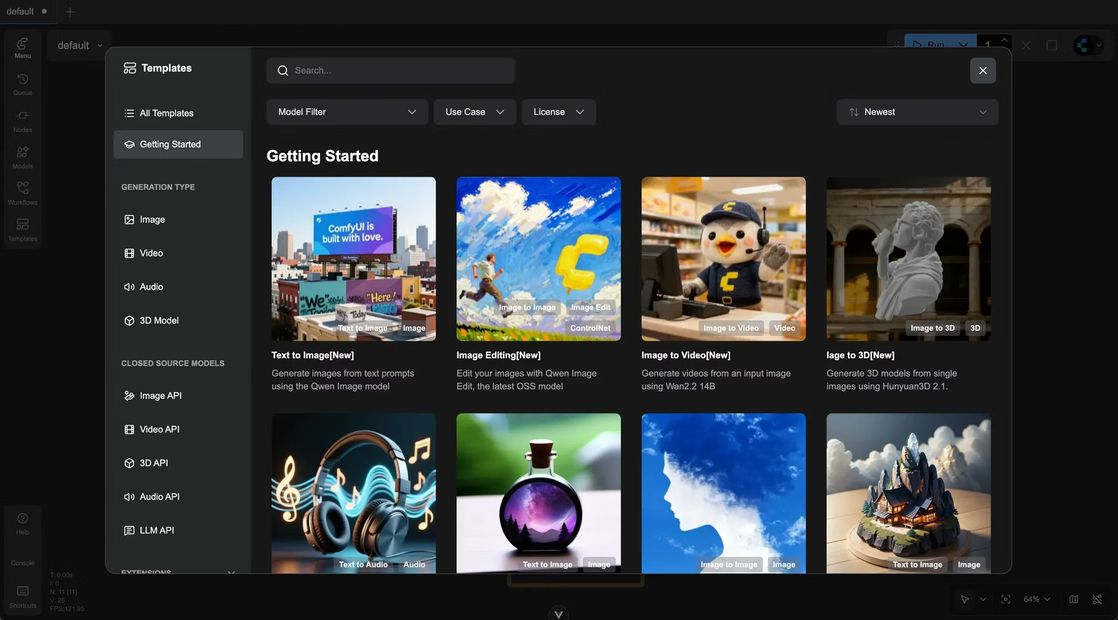

The official hosted version from the ComfyUI team. Blackwell RTX 6000 Pro GPUs with 96GB VRAM, auto-updated nodes and models that track upstream releases, and LoRA uploads from Civitai on Creator plan and up. If you already live in ComfyUI solo, it's the most familiar cloud version you can run, though the runtime caps and node restrictions hit fast.
- +Official hosted version from the ComfyUI team, with the most familiar interface
- +RTX 6000 Pro GPUs with 96GB VRAM
- +Auto-updates track upstream ComfyUI releases
- +Unified credit balance usable in both cloud and local ComfyUI
- +LoRA uploads from Civitai on $35/month Creator plan and up
- −30-min runtime cap (60-min on Pro) kills long video renders mid-flight
- −Limited officially approved custom node list. Most community workflows won't run.
- −No team features at all. No shared runs, assets, or pooled billing.
- −Job queue capped at 4 items vs. 99 on Floyo
- −No free tier. Must pay $20/month just to evaluate the platform.
5. RunningHub
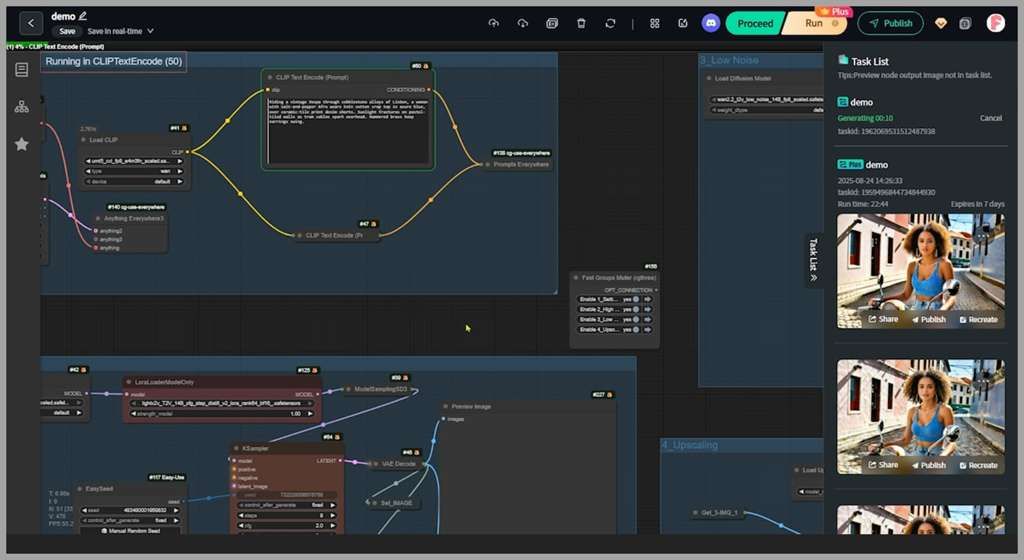
Pay-as-you-go ComfyUI in the cloud, with a creator-monetization angle that's unusual in this category: publish your workflows as AI Apps and earn revenue when others run them. Hundreds of new community workflows added daily, an API available today with up to 50 concurrent calls, and a large node library. Popular with the Chinese AI creator community.
- +API access live today with autoscaling and up to 50 concurrent calls
- +Self-service creator revenue program with direct bank withdrawal
- +AI Apps feature turns complex workflows into simple few-input tools
- +Pay-as-you-go with no monthly subscription floor
- +Free daily credits plus signup bonuses for a low-cost entry
- −No team features. No way to share runs, assets, or billing across users.
- −RTX 90-series GPUs (24 to 48GB VRAM), with lower bandwidth than H100 NVL
- −RH coin system with different rates for subscribers vs. non-subscribers requires math to budget
- −Documentation and community lean heavily Chinese-first
- −Creator program is fully self-service. No dedicated support or onboarding.
5. Runpod
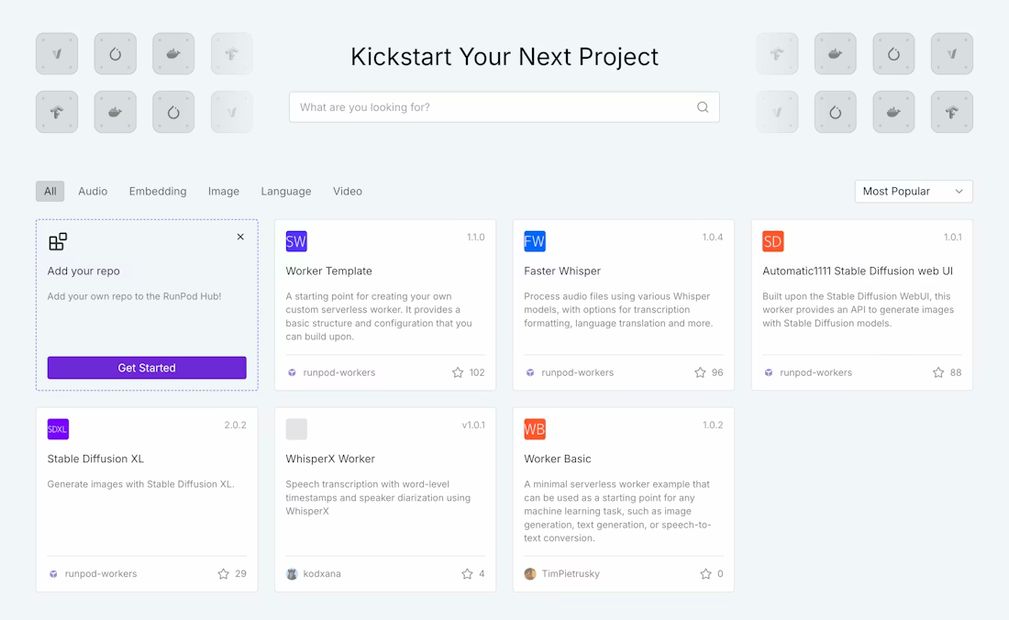
Not really a workflow platform at all. Runpod is raw GPU rental. You spin up a pod (RTX 3090 at around $0.22/hr, RTX 4090 at around $0.39/hr, higher tiers available), deploy a ComfyUI container or anything else you like, and manage the environment yourself. Runpod itself is upfront that it's infrastructure, not a polished SaaS interface.
- +Cheapest pure compute: 60 to 80% less than AWS for equivalent GPUs
- +Full flexibility: any framework, any Docker container, full root access
- +Serverless option bills per-millisecond for API workloads
- +Wide GPU range from RTX 3090 up to enterprise-grade cards
- +Community Cloud offers rock-bottom pricing for non-critical work
- −Very high learning curve. Docker, CLI, and container lifecycle required.
- −Not a creative tool at all. You bring everything on top.
- −No workflow discovery, ecosystem, or prebuilt templates for non-devs
- −No team collaboration features built in
- −You manage maintenance, updates, and environment yourself
Where Floyo Fits
Floyo is browser-based ComfyUI, but built around a different opening question. Not how do I host ComfyUI? The real question is where's the workflow that solves my problem, and how does my team work on it together?
A few things Floyo does that the other ComfyUI cloud hosts don't:
- Real team collaboration. Shared run history means a teammate can open any run you did, see the exact parameters, modify, and re-run. Shared files and LoRAs mean one upload serves the whole team. Workflow pages organize pipelines in one place. None of the other ComfyUI cloud platforms have any of this.
- Serverless billing. On machine-based platforms, you pay for the full session: building workflows, writing prompts, downloading models, reviewing outputs. On Floyo, the meter is off when you're not generating.
- FloTime and API credits are separate. Monthly generation time is one balance; third-party API calls (Kling, Seedance, Sora, FLUX Pro, and so on) draw from a separate API wallet with per-node pricing shown before you run. No billing surprises.
- 300+ custom nodes, 48-hour turnaround. Most workflows from YouTube, Reddit, and CivitAI run out of the box. Request a new node, and it ships within two days.
- H100 NVL GPUs with no runtime limits and a 99-item job queue. Built for video generation, production pipelines, and batch rendering, not capped at 30 minutes per workflow.
You or your team want to go from a creative problem to a finished output without building infrastructure or workflows from scratch. You want discovery, verified workflows, team collaboration, and transparent credit tracking built in from day one, not bolted on later.
How to Pick
The right platform depends on how much you want to build versus how fast you want to ship, and whether anyone else is working with you.
- Designing multi-model pipelines on a canvas: Figma Weave for the widest model roster, Flora if brand-level aesthetic consistency matters most.
- Living in ComfyUI solo with short workflows: Comfy Cloud, if your workflows fit the approved node list and stay under 30 minutes.
- Publishing workflows as revenue-generating apps, or needing API access today: RunningHub.
- A full ComfyUI machine you control with tier flexibility and API deployment: RunComfy.
- An engineer building infrastructure from scratch: Runpod.
- A team, or a solo creator who'll scale into one, that wants discovery, shared workspaces, and serverless billing: Floyo.
The faster you want to go from problem to output, the more discovery and prebuilt workflows matter. The more people you're working with, the more team features stop being a nice-to-have and start being the whole ballgame.
Most creative challenges don't need a new workflow. They need the right one, found quickly, and run cleanly, ideally where your team can see and build on each other's work.
Start with Floyo's free tier. Get 20 minutes of generation time per day, no credit card required. Browse the library, search by what you're making, pick one, and run it.
Try Floyo Free →